
See how your surgical team performs.
10Newtons records brain activity, hand motion, voice and video from everyone in the room on one clock, and turns each case into objective data on skill, coordination and cognitive load.
4
signals on one clock: brain, motion, voice and video
Every role
in the room measured in the same case
1
continuous workflow, capture to insight
Stanford
Founding research
IRCAD
Applied Metrics Pilot
National Academy of Medicine
Founder, elected 2021
Skill, coordination and workload, from the same recording
Surgery is a team activity, and robotics is changing every role in the room. 10Newtons measures each person and the team together, in any procedure, simulation lab or operating room.
Skill that keeps pace with robotics
Surgical teams measured against a mastery benchmark for high optimization with procedure specific metrics.
Teams that work in sync
Surgeon, anesthesiologist, assistants and nurses recorded in the same case on one clock. Shared focus, handovers and interruptions show up on a single timeline.
Workload you can see
Cognitive load is measured per person and per case. Sustained task load is linked to team burnout in published research; seeing where it builds is the first step to reducing it.
Finally, metrics for open surgery
Robotic systems log detailed procedural data; in open surgery this is rare or non existing.
One recording, three points of view
The same case answers different questions for the people in the room, the people who run the department and the people accountable for risk.
Surgeons & Surgical Teams
Objective feedback on your own cases: where focus held, where load spiked, and how your motion compares with your baseline and your peers.
Department and OR leadership
A view of how teams work together across cases and roles, to guide staffing, workflow changes and the adoption of new procedures.
Quality and risk
Evidence instead of opinion for credentialing and privileging decisions, and a record of readiness that hospitals and insurers can rely on.
From the operating room to better procedural outcomes
One continuous workflow turns any recorded session into objective, comparable performance feedback for surgeons and surgical teams.
Capture
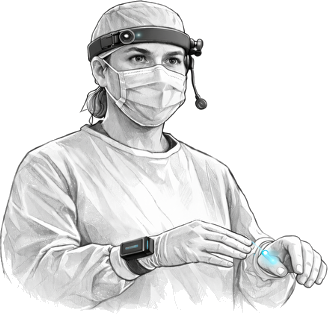
A surgeon wears the EEG band and two hand sensors and records a procedure — right from a mobile device.
Integrate
Brain, motion and audio are uploaded and time synched with procedure video, second by second.
Analyze
The platform computes objective biomarkers and auto-annotates relevant video assets for every phase of the case.
Compare
Results are benchmarked against “practice-ready” standards and mastery metrics for surgeons and surgical teams.
Improve
Surgeons and teams see where they diverge from mastery, engage in VIP training with our strategic partners and reassess performance to track progress.
Built by clinicians, scientists and operators
Led by people who defined the science of sensor-based performance measurement and have scaled regulated medtech before.

Founder & Chief Medical Officer
A Stanford surgery professor and pioneer in using motion and sensor technology to measure clinical skill, Carla founded 10Newtons to turn decades of research into an objective way to measure how surgeons and surgical teams perform. Her work has reshaped how procedural competence is assessed across medicine.



Chief Technology Officer
A technology leader with 30+ years building data and AI platforms in regulated healthcare. He led engineering and privacy at Octave's AI diagnostics platform and earlier advised Nemaris — a surgical-simulation pioneer acquired by Globus Medical — bringing rare command of healthcare AI, compliance, and the operating room to 10Newtons.

Two decades of peer-reviewed research
Objective, sensor-based measurement of clinical performance isn't a hunch. It's a field our founder, Dr. Carla Pugh, helped build. From complex operative procedures to physical exams at the bedside, the work spans all clinical specialties. Recognized by election to the National Academy of Medicine and a recent precision education contract from the American Medical Association.
Operative procedures
Objective, sensor-based measurement of open, laparoscopic and robotic skills.
2018
Shortcut assessment: Can residents’ operative performance be determined in the first five minutes of an operative task?
Motion data from the first five minutes of an operative task predicted overall performance — an early, objective skill read.
View on PubMed2020
Situating Artificial Intelligence in Surgery: A Focus on Disease Severity
A framework for applying AI in surgery that accounts for disease severity and case complexity — not technique alone.
View on PubMed2022
Using open surgery simulation kinematic data for tool and gesture recognition
Motion sensors and deep learning automatically recognize surgical gestures and tools.
View on PubMed2025
Novel Use of Objective Sensor Technology: Creation of Individualized Education Plans to Develop Operative Mastery
Wearable motion sensors set mastery benchmarks and build individualized training plans — the model 10Newtons productizes.
View on PubMedPhysical exam & bedside procedures
The same objective approach applied to hands-on clinical exams and bedside procedures.
2001
Use of a mechanical simulator to assess pelvic examination skills
The origin: objective, sensor-based assessment of a hands-on clinical skill.
View on PubMed2016
Can a virtual reality assessment of fine motor skill predict successful central line insertion?
A virtual-reality fine-motor-skill assessment predicted needle-insertion performance for central line placement.
View on PubMed2020
Use of sensors to quantify procedural idle time: Validity evidence for a new mastery metric
Sensor-measured idle time during intubation separated experienced from novice performers — a validated mastery metric for a bedside procedure.
View on PubMed2024
Sensor-Based Discovery of Search and Palpation Modes in the Clinical Breast Examination
Sensors plus machine learning on 152 physicians — objective force data distinguished mastery-level performers.
View on PubMedThe science of human performance
The foundational science: quantifying mastery to facilitate paradigm shifts in human performance.
2015
Sensor technology in assessments of clinical skill
Sensor-derived force data distinguishes successful from unsuccessful clinical technique.
View on PubMed2019
Combining Metrics From Clinical Simulators and Sensorimotor Tasks Can Reveal the Training Background of Surgeons
Combined simulator and sensorimotor metrics could identify a surgeon’s training background — skill leaves a measurable signature.
View on PubMed2020
Sensors and Psychomotor Metrics: A Unique Opportunity to Close the Gap on Surgical Processes and Outcomes
Motion-tracking metrics quantify distinct dimensions of the surgical process — efficiency, readiness, errors.
View on PubMed2020
Translating motion tracking data into resident feedback: An opportunity for streamlined video coaching
Turning motion-tracking data into targeted resident feedback — a path to streamlined, objective video coaching.
View on PubMedSelected publications. Citations verified against PubMed; full author lists on each linked record.
Measure the team, not just the outcome.
For hospitals, surgical departments and partners who know that you cannot improve what you cannot measure.
or email us directly at contact@10newtons.com